A seasonal wreath is a weekend project with a short tool list. Andrea Hudson, lead florist at wreaths.co.uk, names the kit outright: secateurs, carbon scissors, wire or twine, moss pins, a door hanger, and a wreath wrap, all built around a frame she calls vital, the core everything attaches to. Her method is four steps.
What tools and materials does a beginner actually need?
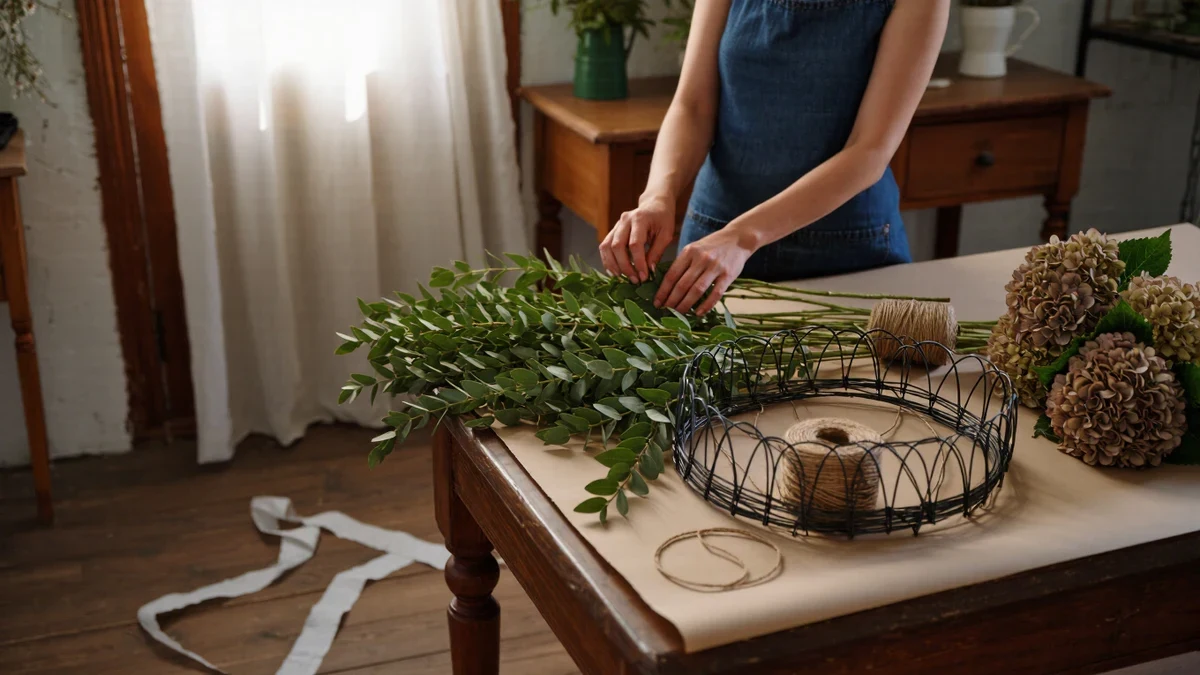
Less than the internet implies. The wreaths.co.uk beginner guide lists six tools, and most households already own two of them. The secateurs prune woody stems; the carbon scissors, meaning fine, sharp blades rather than kitchen shears, cut soft foliage and twine without crushing. Wire or twine binds the greenery down, moss pins hold the damp moss layer to the frame, and the hanger and wrap finish the job at the door.
The frame is the one genuine buying decision, and the guide's emphasis suggests spending deliberation there before anywhere else. The guide is emphatic that the frame is vital and forms the core of the wreath, and it is the component that determines scale: a modest ring suits a townhouse door, a wide one carries a farmhouse porch. Moss, the unsung second material, is both structure and water supply, keeping cut stems alive for days longer than a dry frame would.
Materials are seasonal by definition, which is the craft's whole charm. Early spring offers pussy willow, hellebores, and the first bulbs; autumn returns with seed heads and coloured stems. Nothing about the technique changes between them, only the crate of material carried home.
Which materials suit which part of the year?
The technique is seasonless; the crate is not. The florist's build order, moss first, bundles second, flourishes last, stays identical in March and November, which is what makes the wreath a year-round habit rather than a December ceremony. What changes is the material's temperament: spring growth is soft and drinks quickly, summer offers seed heads and herbs, autumn delivers woody stems and hips, and winter rewards evergreens and dried elements that hold their shape when the moss freezes.
Buy with the week's weather in mind rather than the month's. Stems cut in heat travel stressed and collapse early no matter the season, so the conditioning step, resting material in water after recutting, earns its place as step one. A wreath is only as fresh as its least conditioned branch.
Dried and preserved elements deserve their own note, because they extend the technique to doors that get no shelter at all. A fully dried wreath skips the moss's water function and keeps its structure one, which is a fair trade for a porch in full weather: less life, more longevity. Mixing fresh and dried in one frame is the florist's compromise, with the dried material carrying the shape and the fresh supplying the scent.
What is the four-step process?
The florist's published sequence, in order:
- Condition and prune the foliage. Strip lower leaves, recut stems at an angle, and let material rest in water so it arrives at the frame already hydrated.
- Create the moss base. Bind damp moss onto the frame with wire or twine, secured with moss pins, building the pad that will hold both moisture and stems.
- Bind greenery to the wreath. Lay small bundles of foliage in one direction, wire each down tightly, and overlap each bundle over the last so no mechanics show.
- Accessorise the wreath. Add the seasonal flourishes last, seed heads, dried slices, ribbon, so decoration sits on a finished, living base rather than competing with construction.
Each step rewards a light hand. Bundles that are too thick refuse to lie flat, wire wound too tightly cuts the stems it should be cradling, and accessories added before the greenery is complete have to be undone. For readers who prefer to watch the rhythm before attempting it, Julie's Wreath Boutique's simple-wreath tutorial demonstrates the same bundle-and-bind loop at door scale.
Craft channel Julie's Wreath Boutique demonstrates its easy front-door wreath tutorial, showing the same bundle-and-bind loop described in the florist's four-step guide.
What can go wrong, and how is it fixed?
Most beginner wreaths fail in three documentable ways, and all three repairs happen at the same stage. If greenery droops within days, the conditioning step was skipped or shortened; strip and recut the tired bundles, rest them in water, and rebind. If the wreath reads lumpy or uneven, the bundles were cut too thick, so rebuild with smaller, more frequent bunches, each overlapping the one before. If mechanics show between bundles, the overlap direction slipped mid-wreath, which is a matter of unwinding to the gap and continuing the spiral rather than starting over.
The frame is the remaining culprit. A wreath that spins on its hanger usually sits on a hook too small for the wrap, and a wreath that sags into a teardrop was built heavier at the bottom than the frame gauge supports. Both are fixed at hanging time with a larger hook or a sturdier frame next season, and neither ruins the material already bound.
Speed is the last invisible failure. Every step of the florist's sequence rewards patience in direct proportion: conditioning hours, tight binding, patient overlap, decoration added last. An unhurried afternoon produces a wreath that looks engineered because it is.
Where should a finished wreath hang, and how long will it last?
Out of direct afternoon sun and away from radiators, a mossed wreath keeps its best colour for one to two weeks and its shape far longer, with a light misting extending the green material's season. Between hangs, store the wreath flat in a cool spot and refresh the moss if it dries to powder. A sheltered porch under an overhang is the kindest microclimate a door can offer.
The craft also scales down safely. A table wreath around a candle, a mini frame on a cabinet handle, the same four steps in miniature, brings the season indoors where the weather cannot reach it. These are surface-level decorations only: nothing in wreath making touches structure, wiring, or load-bearing hardware, and a hook that must be screwed into masonry or timber framing is a job for the right tools and a steady assessment of the wall.
Beyond the door, the same skills transfer to the table. A wreath laid flat around candles becomes a runner, a mini frame wired with the season's trimmings settles onto a cabinet pull, and the moss-and-bundle method scales to mantelpiece garlands without new tools. The technique is one; only the frame changes shape.
The honest summary is that a wreath is gardening at door height. Condition the material, build the moist base, bind in one direction, decorate last, and the project repays an afternoon with weeks of the season's specific colour, swapped fresh each time the crate changes.