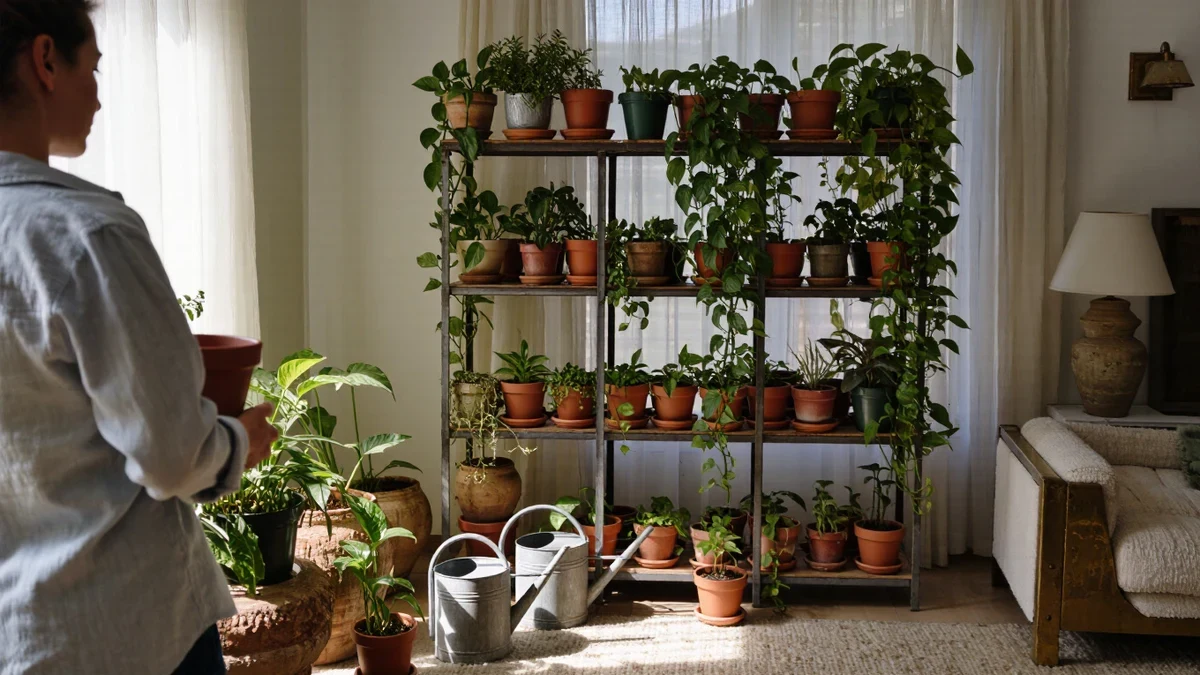
Styling houseplants well is a matter of habit and height rather than a green thumb. The Royal Horticultural Society's Houseplant 101 series, led by Wisley horticulturist Alex Young, organizes the entire subject into a short list of basics, lighting, watering, humidity, repotting, and propagation, and those basics decide whether a shelf of plants reads as design or clutter.
Where should plants go in a room?
Light comes before furniture. The RHS houseplants hub sends beginners to its Houseplant 101 video series for exactly this sequence, tips and advice on growing and caring for indoor houseplants, from the right lighting through buying, watering, feeding, humidity, repotting, soil mixes and propagating. Practically, that means auditing a room's windows before buying anything: a south-facing sill suits succulents and hoyas, while ferns and calatheas prefer the gentler light a few feet back. Styling then becomes placement, grouping plants by the light they share rather than scattering them evenly like ornaments, which is why the best plant rooms cluster greenery at windows and let the rest of the space stay quiet.
Height is the second axis. Trailing varieties earn their keep on high shelves and plant stands, where their growth reads as a cascade rather than a tangle at knee height; upright small plants belong at seated eye level, where their foliage is actually seen across a room.
Which plants suit shelves and small spaces?
Plant supplier Proven Winners' guide to small houseplants puts the selection rule plainly: for small living areas, choose plants that stay small, or grow varieties with a slender upright or trailing habit that will fit in limited space. Its own recommendations lean on shelf- and windowsill-friendly forms, from the compact, pinstriped Prismacolor Birkin to trailing Beautifall snow-and-green hearts, and it notes that small indoor houseplants for tiny spaces can be displayed in space-saving hanging baskets, wall-mounted shelves, and on windowsills.
| Plant | Habit | Care notes, per Proven Winners |
|---|---|---|
| Spider plant | Arching, clumping | Tolerant of neglect and variable conditions; regular moisture, bright indirect light |
| Blue star fern | Upright, low | More adaptable to home environments than other ferns; good beginner choice |
| Prismacolor Birkin | Compact, clumping | Shiny dark green leaves with creamy white pinstripe veining |
| Beautifall Snowy Morning | Trailing | Heart-shaped leaves marbled in green and white |
| Hoyas | Trailing | Let soil dry between waterings |
| Peperomias | Compact mounds | Bright light and warmth |
How do you style a plant shelf, step by step?
The process below uses only what the care guidance already requires, so the shelf works horticulturally as well as visually.
- Match the shelf to the light: reserve the brightest shelf for succulents and the shaded end for ferns, reversing the usual instinct to spread plants evenly.
- Choose pots with one palette, usually plain terracotta or a single matte glaze, so the foliage supplies all the variation.
- Stage in a triangle: one tall plant, one trailing, one compact rosette, repeated along the shelf with breathing room between clusters.
- Let the trailers work: place pothos, hoyas, or inch plants at the shelf edge where their growth can fall freely instead of pooling behind books.
- Build in a care routine: a weekly check of soil moisture by touch, turning pots a quarter so growth stays even, and watering over the sink rather than in place.
How do you keep the look working through winter?
Winter is when styling and care converge. Heating lowers humidity, which the RHS lists among the fundamentals, so grouping plants together on one shelf does double duty, looking composed while raising local humidity around their leaves. Watering should follow the feel of the soil rather than the calendar, since most houseplants slow their growth in short days and need less. Proven Winners' guidance on forgiving species is useful here: its spider plant note, tolerant of neglect and variable growing conditions, performing best with regular moisture and bright indirect light, describes precisely the plant a heated, occasionally neglected living room will forgive. The visible result of good care is the styling: even growth, clean leaves, and trailers that thicken rather than thin.
None of this requires repotting skills or special equipment, and nothing here touches structure or plumbing. The shelf, the light, and a weekly finger test are the entire system, which is the point the RHS's own beginner series makes by starting where every gardener starts, with the conditions the plant actually faces at home.
Which plants suit a dim corner?
Every home has one, the hallway turn, the bookshelf's shaded end, the bathroom with a frosted window, and forcing a sun-lover into it is the most common way a styled shelf fails. The supplier guidance points instead toward tolerance: shade-tolerant foliage plants, forgiving ferns such as the blue star fern, and compact rosette forms that evolved under forest canopy. The practical test costs nothing: leave a candidate plant in the spot for two weeks and watch the new growth. Stems that stretch and lean are asking for more light; steady, compact growth means the corner works. Rotation solves the borderline case, a quarter turn each week keeps growth even, and moving a shelf-cluster two feet toward the window for the darkest months is a styling decision the plants will document in their foliage.
Humidity follows the same low-tech logic. Grouping plants raises the moisture in the air immediately around their leaves, which is why a crowded shelf often outperforms the same plants scattered singly, and why the bathroom shelf is worth claiming in winter. The RHS includes humidity among its fundamentals for exactly this reason, it is a placement decision, not a purchase.
How do you keep a styled shelf from looking cluttered?
Restraint is a horticultural tool as much as an aesthetic one. A shelf carrying five healthy, evenly grown plants reads as composition; the same shelf carrying nine, two of them struggling, reads as clutter. The discipline is to match ambition to light: bright shelves can carry full triangles of tall, trailing, and compact forms, while shaded runs should thin out to three strong specimens and let books or ceramics hold the rest of the line. Dead leaves are pruned the week they appear, since one brown frond pulls the whole shelf's eye, and pots are kept to a single palette so the foliage does the talking. The result, when the care holds, is the look the magazines photograph and the RHS teaches, plants that are visibly alive doing the decorating.
One final proportion keeps shelves honest over years: plants should never outnumber the care available. A household that travels monthly styles differently from one always home, and the tolerant species in the supplier guidance exist precisely for the first case, spider plants, sturdy ferns, and compact rosettes that forgive a missed week. Starting with three plants and adding only when all three thrive beats beginning with ten and watching the shelf thin, because an empty gap where a plant died is the one styling note no arrangement can absorb. The shelf, in the end, is a small ecosystem with a design brief, and both halves have to be fed.