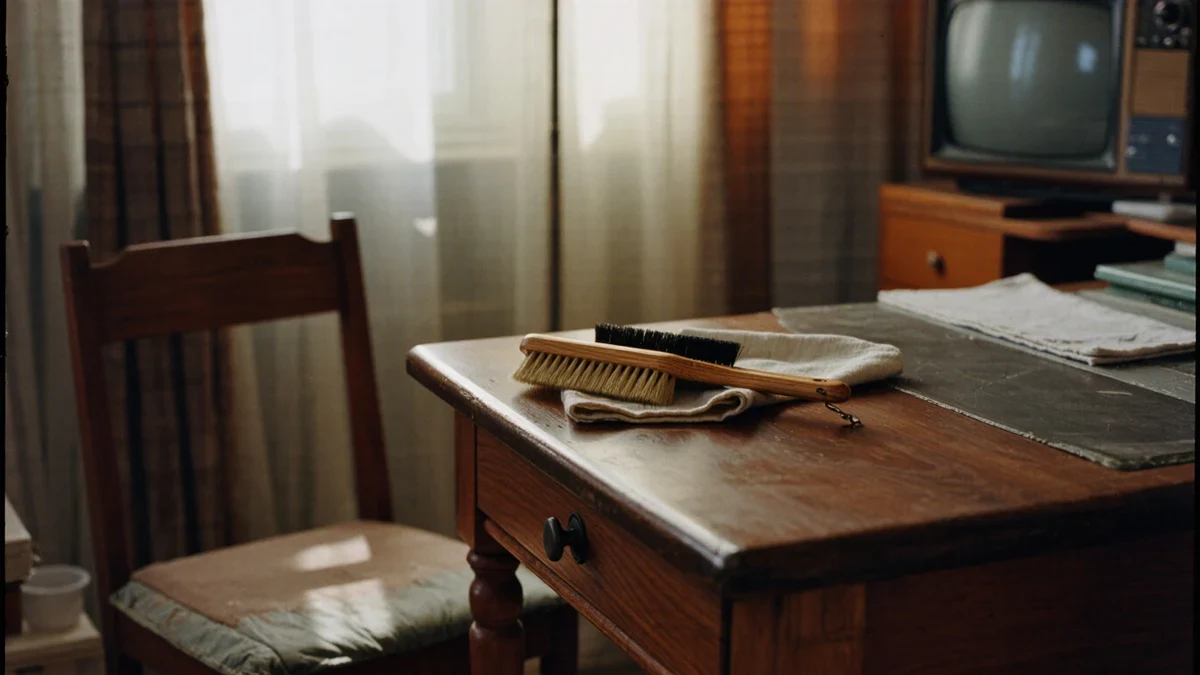
Wooden furniture survives on prevention, not products: stable humidity, low light, and regular dusting with a slightly damp cloth. That is the care the Canadian Conservation Institute, the Government of Canada's conservation research center, recommends — and it warns that light damage to wood is cumulative and irreversible.
What does wood actually need to stay healthy?
Stable moisture. In its published basic-care guidance, dated November 14, 2018, the Canadian Conservation Institute explains that "when moisture in the air increases (i.e. humidity rises), wood absorbs water and swells a little," while drier air makes it shrink — the cycle that splits joints, cracks finishes, and warps tabletops. Keeping a room's humidity reasonably steady matters more than any polish.
Light is the second enemy. Because damage accumulates and cannot be undone, a walnut credenza belongs out of direct sun, and curtains or films that diffuse light are part of furniture care, not just window dressing.
How should you clean and move wooden furniture?
Gently, and by lifting. The Institute's handling guidance says to "check furniture for damage or loose joints before moving it" and to "lift a table by the apron or legs instead of the top" — the top is the most vulnerable surface and the worst place to grip. On cleaning, its advice is that "one of the best ways to clean wood is to dust regularly with a slightly dampened cloth."
Good Housekeeping's UK edition, in its published furniture-care advice, agrees that "the best way to stop wooden furniture from being damaged is prevention," directing readers to "dust regularly with a soft cloth" and to "remove sticky marks with a cloth wrung out in a warm, mild solution of soapflakes." Its experts also trace white rings to physics: "these form when moisture from a wet glass or a hot dish becomes trapped in the finish of the wood" — which is why coasters are furniture care.
What belongs in a simple care routine?
A non-structural routine a careful owner can safely run, assembled from the two published guides:
- Dust weekly with a soft, slightly dampened cloth, following the grain; dry immediately.
- Lift — never drag — pieces when moving them, gripping aprons and legs, with a second person for anything heavier than a dining chair.
- Keep pieces out of direct sunlight and away from radiators and other heat sources.
- Use coasters and mats under glasses and hot dishes so moisture never sits against the finish.
- Remove sticky marks with a cloth wrung out in warm, mildly soapy water, then wipe with a clean damp cloth and dry.
- Check joints and hardware a few times a year and address looseness before it grows.
What about polishes, oils, and the products advertised as restorers?
Less is more, and often less is all. The conservation guidance at the center of this piece recommends nothing beyond the damp cloth for routine care; commercial polishes and silicone sprays can leave films that complicate any future refinishing, which is why museums avoid them on collection furniture. An owner who wants to feed a dry, oiled finish should use the oil the maker or finish supplier specifies, sparingly, on a cloth — never poured — and stop at the first sign of stickiness. Wax, applied thinly once or twice a year on pieces finished for it, is the one traditional addition both guides tolerate, buffed off rather than built up.
White rings, per Good Housekeeping's explanation, sit in the finish rather than the wood, which is why mild warmth or gentle abrasion sometimes lifts them. Anything that penetrates below the finish — black moisture marks, splits, lifting veneer — is beyond home treatment.
What does a house's climate have to do with a chair?
Everything, seasonally. Winter heating dries interior air sharply; radiators and forced-air vents are the enemy parked beside the dining table, and a piece sitting in their stream will open joints by spring. Summer humidity swings the other way. Moving precious wood a few feet from the heat source, keeping a steady moderate temperature, and dusting weekly — the routine costs nothing and is the entire conservation program for most homes, per the Institute's published guidance. The same logic extends to attics and basements, where humidity and temperature run uncontrolled: neither is a place to store good wooden furniture, however convenient the square footage.
When should a professional take over?
Structural repair, veneer loss, deep splits, and finish failures on significant pieces are not homeowner projects; they belong with a trained furniture conservator, whose treatments follow the same preventive science the Institute publishes. The line is simple: cleaning and prevention at home, intervention in the workshop. Anyone who owns a piece with documentary value — a maker's label, a known provenance — should ask a conservator before applying anything to the surface beyond a damp cloth.
The reward for the quiet routine is plain, per Good Housekeeping's care guidance: wood that keeps its color, joints that stay tight, and finishes that read as the maker left them.