Sofa cushion fillings come down to three materials: foam, feather, and fiber. Foam holds its shape and offers the firmest seat. Feather and down sink and soften, then need daily attention. Fiber sits between them, lighter than foam and cheaper than feather, but it flattens sooner.
The filling also decides the workload. A foam-core cushion keeps its silhouette with almost no effort. A feather-wrapped seat asks to be plumped every time someone stands up. Knowing which is inside the cover — and what that material will ask of the household — is the difference between a sofa that ages well and one that looks tired within a few years.
What are the main types of sofa cushion fillings?
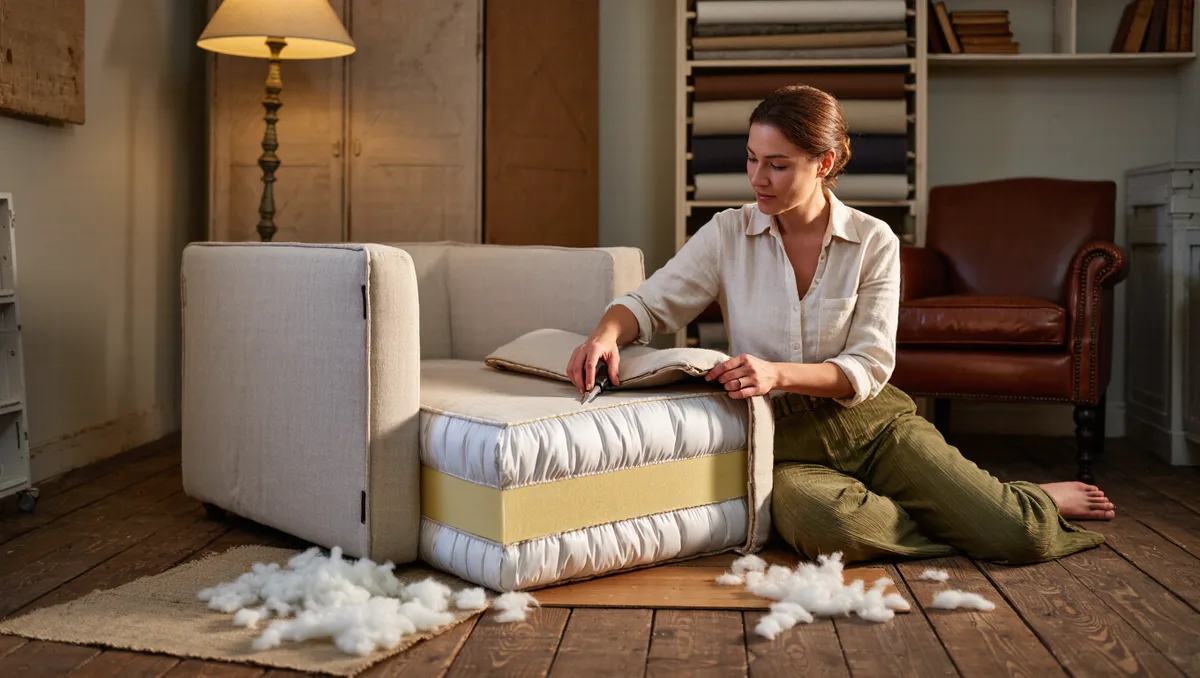
Three fillings dominate the market, and most sofas use one of them, or a blend of two. Foam is the workhorse: a slab of polyurethane, sometimes of varying firmness layered within a single cushion, cut to shape and wrapped in batting. Feather-and-down cushions are fabric cases filled with loose feathers, often wrapped around a firmer inner core so the seat does not collapse entirely. Fiber fills use polyester, either as loose clusters or as a bonded pad, to imitate the softness of down at a lower price.
Each filling produces a distinct sit. Foam pushes back; feather gives way; fiber compresses quickly and then goes flat. The trade is always the same: resilience on one side, softness and upkeep on the other.
How does foam age, and what should a buyer look for?
Foam is judged by density — how much material is packed into a given volume — and higher-density foams resist the crumbling and sagging that eventually claim cheaper seats. A well-made foam core should keep its height and edge for many years of daily use. A low-density one compresses permanently, so the cushion develops a sitting hollow that no amount of flipping will fix.
Foam's other virtue is that it asks nothing of the owner. There is no plumping, no reshaping, no seasonal attention. Retail listings make the firmness visible: IKEA, for instance, labels its sofas across a range from soft and extra soft to medium firm and firm, so a buyer can match the seat to how the household actually lounges. The honest drawback is character. Foam alone can feel flat — supportive, but without the yielding quality that makes a deep seat feel luxurious. That is why many better sofas pair a foam core with a softer wrap, taking the shape-holding of one material and the hand-feel of the other.
Why do feather cushions need so much attention?
Feather and down are the softest seats available, and the least self-sufficient. Loose fill shifts with every sit, so the cushion must be plumped from the corners after each use or it settles into a lumpy pancake. This is not a defect; it is the material behaving as feathers do. The reward is a seat that molds to the body and reads as relaxed and generous in a room.
Pure feather seats are rare in modern sofas for exactly this reason. The common construction is a feather-and-down jacket around an inner foam or fiber core — softness on the surface, structure underneath. Even so, the outer layer still needs regular plumping, and feather fills benefit from an occasional full fluff to redistribute the fill. Households that will not maintain a daily ritual should weigh that honestly before choosing this filling, however good it feels on the showroom floor.
Is fiber filling a compromise or a genuine option?
Fiber filling is the honest middle. A polyester fill costs less than feather, weighs little, and is often hypoallergenic in a way natural down is not. It gives a soft initial sit similar to down, which is why it appears on so many family sofas. The trade is lifespan: fiber compresses faster than foam and does not recover as fully, so fiber-filled seats tend to flatten first in a mixed sofa.
That flattening is manageable with the same habit feather requires — regular plumping and turning — but it arrives sooner. For a first apartment, a playroom sofa, or any seat expected to serve hard for a short season and then be replaced, fiber is a sensible choice. For a sofa intended to anchor a room for a decade, foam or a foam-and-feather combination is the more durable contract.
How should cushions be cared for, whatever the filling?
Removable cushions make every filling easier to live with, and they are common enough that buyers should treat them as a baseline feature. Costco's sofa listings, for example, point to deep seating with removable cushions as a comfort feature across its range — and removability matters beyond comfort, because a cushion that comes out can be rotated, aired, and turned so wear spreads evenly.
The practical routine follows the material:
- Foam: rotate and flip cushions monthly so both faces wear evenly; vacuum the covers rather than washing the cores, since wet foam dries slowly and can hold moisture.
- Feather and down: plump after each use, working the fill back into the corners; air the cushions periodically to keep the fill lofted and fresh.
- Fiber: plump and turn frequently — more often than foam — because the fill compacts with each sit; expect to rebuild loft by hand rather than waiting for it to recover.
Zip-off covers should be laundered according to their own labels, and the fabric choice matters as much as the filling for how a sofa wears over the years; the separate guide to upholstery fabrics, from wool to performance weaves, covers that half of the equation. We covered a connected angle in Upholstery Fabrics Explained: Wool, Performance Weaves, and Barrier Textiles.
What does this mean for choosing between them?
Our analysis of the three fillings comes down to a single question: how much maintenance will the household actually perform? Foam rewards the low-effort owner with the longest tidy lifespan. Feather rewards the attentive one with the best seat in the house. Fiber splits the difference on price and on longevity, and suits buyers who value softness now over structure later.
A useful test in any showroom is to lift a cushion. A heavy, dense cushion signals a foam core built to last. A light, floppy one signals fiber or a light fill, and with it a shorter horizon. Then sit, stand, and look: a quality seat springs back to shape; a lesser one keeps the impression. Firmness labels help at the catalog stage — IKEA's range runs from extra soft to firm on the same shelf — but the lift test tells the truth about construction. Readers following this should also see Which Wood Joints Should You Look for in Quality Furniture?.
One caution belongs in every purchase conversation: lifespan claims are the seller's own, and no brand can be treated as an independent judge of its own durability. Ask what is inside the seat, in plain terms — core material, wrap, density where stated — and weigh the answer against the care routine the household can honestly sustain.
The bottom line on sofa cushion fillings
The evidence comes back to three honest positions. Foam is the durable, low-maintenance choice, at its best in a high-density core, possibly softened with a wrap. Feather and down deliver the deepest comfort and demand a daily plumping habit in return. Fiber offers down-like softness at a friendly price and flattens first. None is wrong; each suits a different kind of life. Match the filling to the household's habits rather than to the showroom moment, and the sofa will age the way the buyer expects — which is the whole point of knowing what is inside the seat.