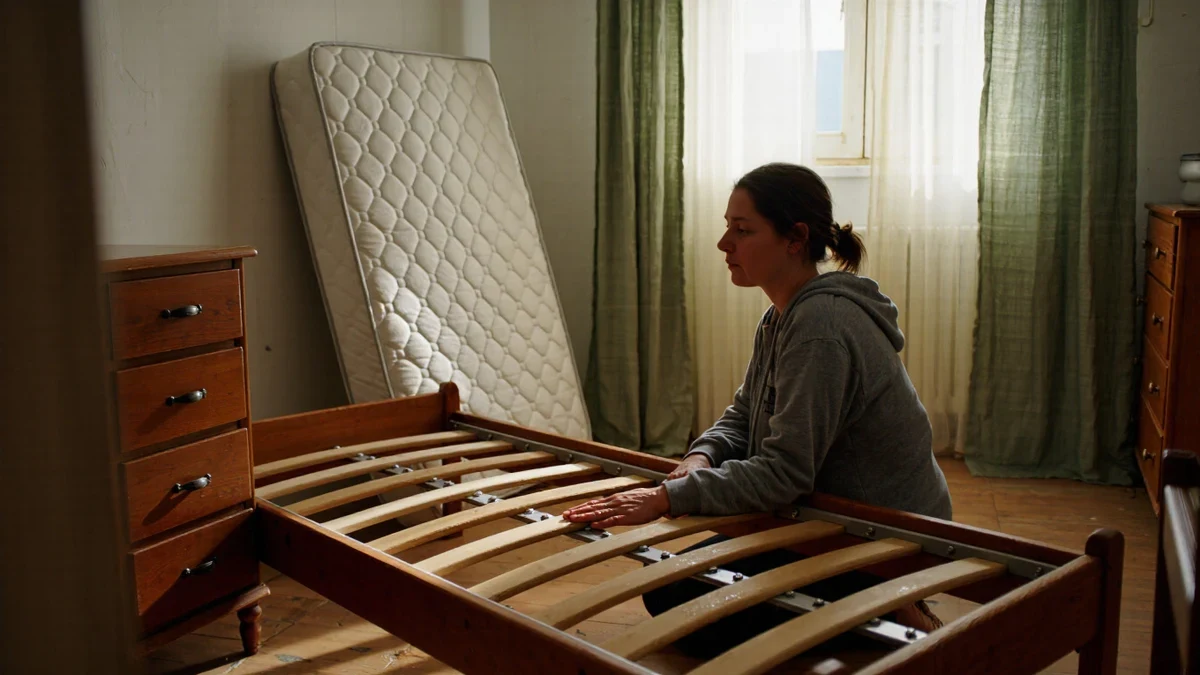
A mattress is only as good as what sits beneath it, and mattress maker Saatva settles the biggest confusion at a stroke: panel beds require a box spring, while platform beds carry a mattress on their own base. On a panel bed, the brand's guide states, the wood slats alone are not enough to support a mattress.
What is the difference between a bed frame and a foundation?
The frame is the visible architecture, headboard to legs, while the foundation is the working surface the mattress actually rests on. A foundation may be a box spring, a rigid slatted platform, or a solid panel, and the mattress industry treats them as different products with different jobs. In Saatva's comparison of panel and platform beds, the brand explains that platform beds have a large, sturdy base that can be used as a mattress foundation without the addition of a box spring, whereas panel beds are built expecting one.
This matters at the moment of purchase more than at any other time. A buyer who pairs an innerspring mattress with a low platform, or a foam mattress with a sparse set of widely gapped slats, is working against the construction of both products. Makers publish base requirements for exactly this reason, and the published guidance, not a salesroom shorthand, is the document worth consulting before the frame arrives.
The vocabulary is worth slowing down for, because listings use it loosely. A bed frame is the structure; a foundation is the support surface; a box spring is one specific kind of foundation built around springs; a platform is a foundation integrated into the frame itself. When a listing says a bed requires a box spring, it is describing a panel bed; when it says a box spring is optional, it is usually describing a platform. Reading every product page with those four definitions in hand turns a confusing furniture category into a legible one, and it is the single habit that prevents the most common and expensive mismatch: the right mattress on the wrong base.
It also matters for height, and height is where taste enters. Foundations add inches, and low-profile versions subtract them, so the choice between a panel bed with a box spring and a platform bed is partly a choice about how the bed meets the floor and how much under-bed storage survives. The frame decision is a room decision as much as a mattress decision.
Do platform beds really support a mattress without a box spring?
On the platform side, yes, by design: the base itself is the foundation. Saatva's guide states plainly that you don't need a box spring or mattress foundation on a platform bed, and that a box spring can still be layered on if a sleeper wants to raise the mattress height. The brand's guidance adds that foam mattresses, meaning memory foam or latex, may deliver better support when used with a platform base.
Innerspring is the exception the guide flags. Because an innerspring unit is built to flex against a box spring's responsive grid, Saatva describes it as the mattress type least suited to a platform bed, requiring a box spring for what the brand calls optimal support. Some hybrids fall in between, and the maker's own care documentation is the tiebreaker.
For a reader restyling a bedroom, the practical translation is straightforward. A platform bed buys a cleaner, lower silhouette and one less component to buy. A panel bed buys the traditional stacked profile and, with the right box spring, a sleep surface engineered as a pair with the mattress. Neither is the better bed; each is a system, and the mattress has opinions about which system it belongs to.
How do you choose between frame types for a specific mattress?
Start from the mattress and work outward, because the base requirements travel with the mattress, not the headboard. A foam or latex mattress is the natural companion to a platform base, while an innerspring expects the give of a box spring. Once that pairing is settled, the remaining choices, frame height, under-bed clearance, and style, are genuinely free ones.
The table below condenses the makers' published distinctions into a shopping comparison:
| Base type | Box spring needed? | Best-matched mattresses, per makers' guidance | Typical profile |
|---|---|---|---|
| Platform bed | No, base acts as the foundation | Memory foam and latex; some hybrids | Low, clean silhouette |
| Panel bed with slats | Yes, slats alone not sufficient | Innerspring; some hybrids | Traditional stacked height |
| Platform plus box spring | Optional, used to add height | Any mattress that accepts a box spring | Raised, layered look |
Where a room already owns a frame the mattress doesn't love, the fix is usually a foundation rather than a new bed: the box spring or platform insert that reconciles the two. That is a smaller purchase and a smaller regret.
What are the signs a bed frame needs replacing?
Frames announce their failure before they collapse, and Saatva's guide to replacing a bed frame lists the tells in order of drama. The first, according to the brand, is sound: if you hear any creaking, that is usually the first sign that a bed frame isn't at its prime anymore. Noise means joints or slats are working loose, and loose parts under a nightly load only loosen further.
The second sign is the state of the slats themselves. The guide notes that it might be that the slats got bent or even broken over time, and that especially if there are cracks or splits in the slats, a replacement is needed as soon as possible. One broken slat might not seem like a big deal, the brand writes, but the problem will only get worse if left alone, because the neighbouring slats inherit the load.
The consequence of ignoring these signs lands on the mattress, not just the frame. A surface that no longer sits flat develops zones of uneven pressure, and the mattress slowly takes the shape of whatever is failing beneath it. Inspecting slats when rotating a mattress, a minute with a torch and a tug, is the maintenance habit that catches trouble while it is still furniture-sized rather than sleep-sized.
How should a reader maintain the support under an existing bed?
Maintenance is modest but real. Check that slats sit fully in their brackets or rests after any move, since a slat knocked half out of its channel is a slat doing half its job. Tighten visible bolts at the frame's corners and centre leg on the same schedule as the mattress rotation, and keep the area under the bed clear enough that air can move, because the makers' ventilation logic works both ways.
Finally, keep the mattress maker's own base requirements with the warranty paperwork. The published guidance from the brand that actually built the mattress outranks every general rule, including the tidy ones above. Where a frame is inherited, second-hand, or simply old, matching its realities to those requirements is the whole discipline of mattress support, and it takes an afternoon, not a renovation.
Second-hand frames deserve the same audit with more suspicion, because their history is undocumented. Every question in the checklist above still applies, plus the ones a previous owner cannot answer: what mattress sat here, how many moves did the frame survive, and were the slats ever replaced with a different gauge. A vintage frame with sound joinery is often the best-built object in the room; a vintage frame with improvised slats is a new mattress waiting to sag.
The last habit is documentation. Keep the maker's base requirements, the warranty terms, and the frame's assembly instructions together in the same place the warranty lives, because the day a creak appears or a slat cracks is the day those papers answer the question of what, exactly, the maker promised. Support is the least glamorous chapter of bedroom design and the one with the longest consequences; the makers have written their half of the guide already, and the reader's half is mostly reading.