An entryway succeeds on three acts: a mirror, a surface, and somewhere for the daily cargo of coats, keys, and shoes. Bob Vila's entryway guide pairs a strategically placed mirror with a space-efficient demilune console — two pieces that give even a plain hallway the posture of a designed room without blocking a single step.
What does every entryway need?
The mirror is first for reasons both practical and optical. A mirror placed at the entry, as the guide's entry on the subject puts it, lets guests see themselves in the comfort of the home, and it doubles the light of whatever lamp or window the hall can spare. In a windowless passage, a mirror opposite the door harvests daylight from the one moment the door is open and lends it back all evening.
The console comes second, and its ideal form is the demilune — the half-round table whose flat back hugs the wall while its curve keeps the walking lane clear. A demilune takes a bowl for keys, a lamp for the evenings, and a stem of whatever the season offers, and asks almost nothing in return. Against it, one chair, properly chosen, turns the arrangement from a still life into a working system: the place where a boot is tugged off and a bag is set down.
How do you handle a narrow or storage-poor entry?
Narrow halls fail in a characteristic way: storage arrives as tall, deep furniture that turns a passage into an obstacle. Bob Vila's guide answers this with a build that keeps everything low — a credenza made from an IKEA cabinet wrapped in plywood and mounted low on the wall, a solution the guide credits to a reader project and praises for adding expansive storage without the teetering, sky-high cabinets that make small foyers nervous places.
The principle generalizes. In a tight entry, storage below waist height reads as architecture, while storage above it reads as clutter; closed fronts read calmer than open shelves of visible shoes; and a single run of low pieces leaves the upper wall free for the mirror or a pair of prints that do the room's decorating. Depth matters as much as height — a 12-inch-deep console passes in a hallway where an 18-inch case piece blocks the door swing.
What if there is truly no room for storage furniture?
The honest answer, from Bob Vila's mudroom-alternatives feature, is that not every home has or needs a full mudroom, but every household needs a place to handle the comings and goings of busy family life and all its gear. The feature's fourteen ideas span a range of budgets and space limitations precisely because the problem is universal: the gear exists whether or not the room does.
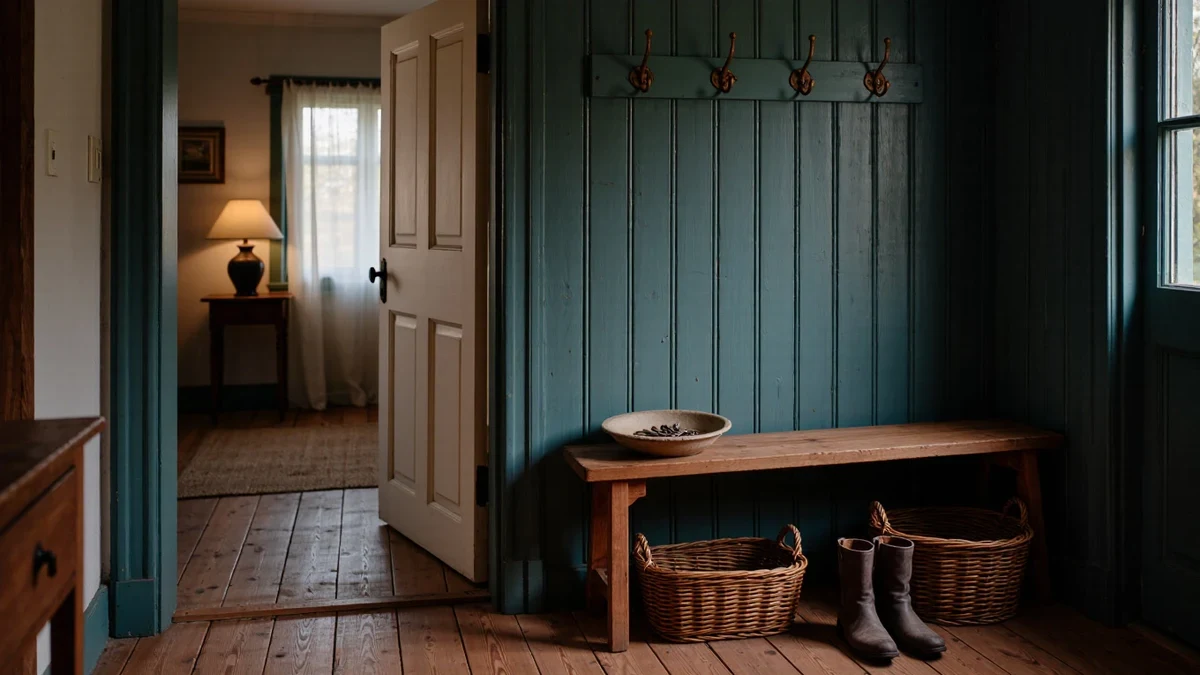
Where no floor plan offers a footprint, the wall does the work. A row of hooks at two heights takes adult coats and children's backpacks; a narrow bench, even one pulled from another room, gives the sitting spot that makes shoe changes civilized; a tray or a pair of baskets by the door contains the wet and the muddy without a built-in anything. Each piece is freestanding, renter-friendly, and movable the day the household changes shape.
| Piece | What it does | Best footprint |
|---|---|---|
| Demilune console | Keys, lamp, seasonal stems | Half-round, 12–16 in deep |
| Entry mirror | Last look, borrowed light | Wall-hung, no floor space |
| Low credenza | Hidden daily storage | Waist height, mounted or legged |
| Hook row plus bench | Coats, bags, shoe changes | Wall zone, bench 12–14 in deep |
How do you keep the entry looking composed?
Composition is subtraction. One mirror, one surface, one seat, one container for the daily dump — and the discipline to let each piece do its job. The mirror stays clear of the console's lamp in reflection; the console holds three objects at most; the tray by the door absorbs the keys and post so the demilune never has to. Lighting finishes it: a lamp on the console at seated eye height, or a warm ceiling fixture on a dimmer, so the room that opens the home never greets anyone with glare.
Designed this way, an entryway without a mudroom is not a compromise. It is a small, complete room — the one every guest meets first and every resident touches last — built from pieces modest enough to fit any hall and arranged carefully enough to make the whole house feel considered from the first step inside.
What lighting suits a hall with no window?
Windowless entries live or die by layered light, and the lamp on the console is only the middle layer. A ceiling fixture on a dimmer gives the hall its working brightness — the pass-through light for coming home with bags — while the console lamp at seated eye height gives the room its evening register, and a small battery or plug picture light on the mirror or a frame above gives the finishing warmth. Three low-wattage sources at three heights will always out-perform one bright fitting at making a small room feel inhabited rather than merely illuminated.
Color temperature does the rest. A hall lit at a warm temperature welcomes; the same hall lit cold reads like a corridor in an office building. Where the mirror hangs opposite the door, its returned light doubles whatever warmth the fixtures put out — which is the optical reason the mirror comes first in every entry plan, before storage, before seating, before decoration of any kind.
How do you style the console through the seasons?
The console earns its keep by changing. A flat surface at the door is the house's calendar: a bowl of keys and a lamp as the permanent residents, with one rotating vignette — stems in spring, a bowl of apples in autumn, a small stack of books and a candle through winter. The discipline is a count of three: lamp plus two objects, or bowl plus lamp plus stems, and nothing more. Every additional object subtracts from the surface that makes the entry work.
Height contrast is what keeps the three objects composed rather than accumulated: something tall (the lamp or the stems), something low (the bowl or the books), and something in the leaning middle, like a small framed print propped rather than hung. Swapped seasonally and edited ruthlessly, the same demilune that carries February's candlestick carries July's peonies — the entry refreshes itself four times a year for the price of a market bunch.
How much does a renter-friendly version cost in function?
Nothing, if the pieces are chosen honestly. Hooks with damage-free adhesive strips hold a coat and a tote; a wall mirror hung on a single rated anchor fills the light-borrowing role; a secondhand bench does the shoe work; a lidded basket by the door contains the daily dump. The mudroom-alternatives feature's promise — solutions across a range of budgets and space limitations — is really a claim about method: match each of the entry's three acts to a movable, wall-kind piece, and the room assembles in an afternoon and departs without a trace.
Owners gain the same freedom. The low-credenza route and the hook-and-bench route both leave walls patchable and layouts reversible, which suits the entry better than any built-in: of all the rooms in a house, the hall is the one whose cargo changes most — children grow, sports change, boots give way to sandals — and the entry that adapts is the entry that keeps working.