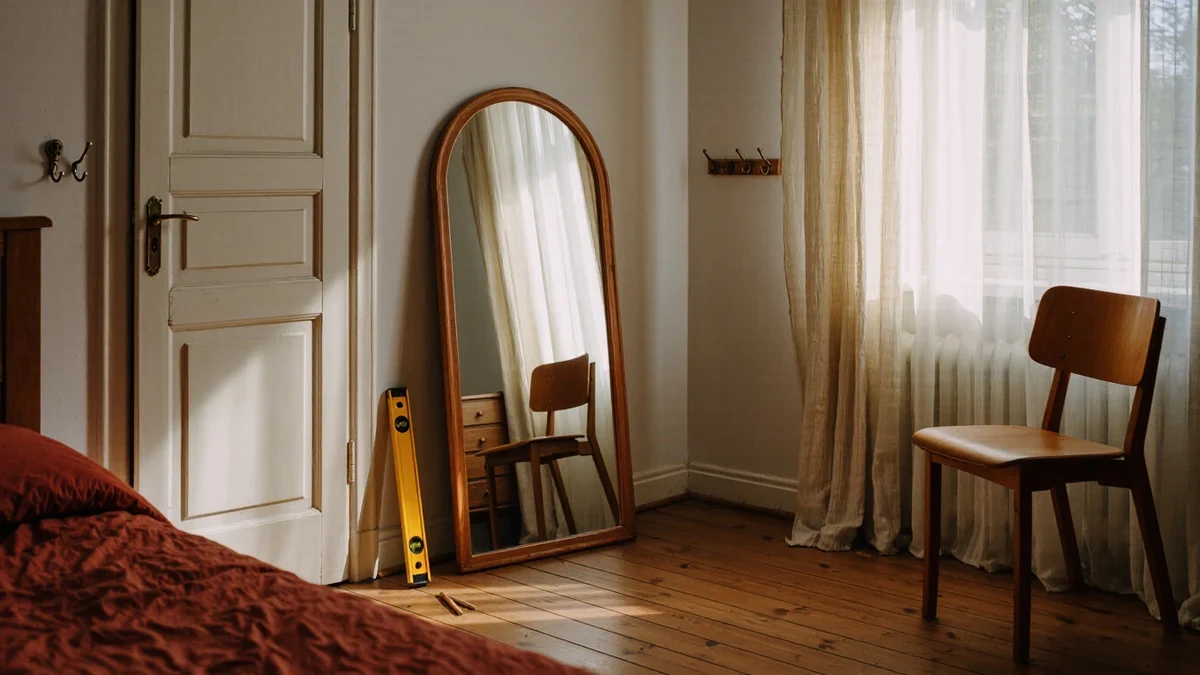
A heavy mirror stays on the wall only when two decisions match: where it hangs and what holds it. Hardware maker OOK, whose cleat systems are built for exactly this job, says a well-placed mirror enhances a room's sense of space and light — and its published guidance treats weight distribution, not luck, as the reason it stays there.
Where should a mirror hang?
Placement is a lighting decision before it is a decorating one. A mirror opposite or adjacent to a window doubles the daylight a room receives at the hour it matters; a mirror at the end of a dark passage pulls light down the hall; a mirror behind a lamp or a pair of candles returns the evening's warmth. The entryway convention — a mirror at the door for that last look — is recorded in Bob Vila's entryway guide, where a strategically placed mirror is paired with a slim console as the hall's working centerpiece.
Height follows the viewer, not the wall. In circulation spaces, hanging so the average eye meets the glass a bit above center keeps the mirror useful to everyone from teenagers to grandparents; over a console or a sideboard, a mirror two-thirds the width of the piece below it reads as composed. What placement cannot fix is physics: a mirror meant to lean, flip, or swing belongs to hardware rated for that movement, which is where the wall side of the job begins.
Which hardware holds a heavy mirror?
The published guidance sorts cleanly by wall and weight. For heavy mirrors, OOK's hardware tutorial recommends cleats — interlocking strips, one screwed to the frame, one to the wall — because they distribute weight evenly across the length of the piece and provide flush, level support on various surfaces without requiring wall studs behind every fixing. For a 30-pound mirror on ordinary drywall, a single cleat rated well above the weight does the work of four point-fasteners.
Where a cleat is not an option, anchors carry the load. In Bob Vila's mirror-hanging guide, contributing writer Mark Clement — a working contractor — recommends a winged anchor designed to hold the weight of the mirror or more, naming the Hillman Pop-Toggle as one option whose screw can be withdrawn and reinserted while the position is still being dialed in. For brick, his go-to is a multi-material masonry screw. The common thread is explicit: the anchor's rating, not the mirror's price, decides what goes on the wall.
| Wall or surface | Published recommendation | Why it holds |
|---|---|---|
| Drywall (heavy mirror) | French cleat system (OOK) | Distributes weight along the wall, flush and level without studs |
| Drywall (point fixing) | Winged anchor, e.g. Hillman Pop-Toggle (Bob Vila) | Rated to the mirror's weight or above; screw is repositionable |
| Brick or masonry | Multi-material masonry screw (Bob Vila) | Bites the masonry behind the surface |
What is the hanging sequence?
The two published guides combine into a process a careful reader can follow with a drill, a level, and a stud finder.
- Weigh the mirror, or find its documented weight, and choose hardware whose rating exceeds it — a cleat for heavy pieces, a rated anchor otherwise.
- Hold the mirror in place, mark the top edge, and set it aside; measure the distance from the mirror's hanging point to its top edge.
- Transfer that measurement to the wall, check for studs or pipes with a stud finder, and mark the fixing line with a level.
- Install the wall-side cleat or anchors at the marked line, drilling into studs wherever the positions allow.
- Seat the mirror's frame cleat onto the wall cleat, check level a final time, and test the hang with a firm downward press before letting go.
When should a professional take over?
Some walls answer the question themselves. Brick, brittle old plaster over unknown lath, tile, and any wall that may conceal pipes, wiring, or ducts deserve a licensed professional or a qualified contractor with the right masonry tools — the sort of wall work whose failure mode is not a scuffed paint patch but a room hazard. Mirrors above head height, extra-large gym or leaning mirrors, and anything hung over a bed or a seating position warrant the same caution, because a falling mirror is glass at speed.
Within those limits, the job rewards patience over strength. Placed to borrow light and hung on hardware rated for the weight, a mirror is one of the few interventions that changes a room's dimensions without moving a single wall — which is why getting the two decisions right, position and hardware, is the whole of the task.
How do you use mirrors to make a small room read larger?
The enlargement trick is real but specific: a mirror works when it reflects something worth doubling. Placed opposite a window, it brings the outdoors in a second time; placed opposite a lamp-lit console, it doubles the warm pool of light; placed at the end of a narrow room, it extends the sightline and gives the eye a place to land. Placed opposite a cluttered bookcase or a radiator, it merely doubles the clutter — the rooms mirrors enlarge are the rooms already composed.
Scale decides whether the mirror opens a room or merely decorates it. A small mirror on a large wall reads as a pendant; a mirror that fills a meaningful fraction of the wall — the full height between console and molding, or the width of the hallway — performs the architectural work. This is the logic behind the current fashion for oversized leaning mirrors: at six feet and more, they reflect an entire room from floor to ceiling, though a mirror of that size leaning rather than hung is a stability decision that belongs to professional-grade anti-tip fixing, not to furniture pads alone.
What about mirrored walls and grouped mirrors?
A pair or trio of smaller mirrors hung as a group carries some of the same light-harvesting benefit with a gentler commitment, and it lets a household mix frames — round brass over rectilinear black, vintage over new — the way a gallery wall mixes periods. The hanging rules stay identical: each mirror on hardware rated for its weight, each checked with a level, and the group's centerline held at the eye height that suits the people who use the hall. Template paper, cut to each mirror's outline and taped to the wall, lets the composition be argued with before a single hole is drilled.
Full mirrored walls belong to a different conversation — they are fixed installations with glazing and safety considerations, and the reader tempted by them should be talking to a glazier and a contractor, not following an article. The line is the same one that runs through this whole subject: hanging a mirror is a weekend task; glazing a wall is construction, and the difference is worth respecting in both directions.
How do you keep a hung mirror honest over time?
Mirrors ask for two check-ins a year, and both take minutes. The first is the hardware check: a gentle press at the frame's corners to feel for movement, and a look at the anchors or cleat for any shift — winged anchors, as the Bob Vila guide notes, allow a screw to be withdrawn and reinserted, so a small correction is a turn of the screwdriver rather than a new hole. The second is the glass check: a wipe with glass cleaner on the mirror face and, for framed mirrors in bathrooms or entryways, a look at the frame's lower rail, where moisture and winter salt collect.
Done twice a year, the routine keeps a mirror where it was hung for decades — level, clean, and quietly doing the two jobs every mirror is actually employed to do: lending a room the light it lacks and the depth it wishes it had.